Table of Contents

Preparatory Steps
Remove
Clean and Inspect for Reuse
Install
Adjust
Finishing Steps


Preparatory Steps

TOC
 WARNING 

Batteries can emit explosive gases. To reduce the possibility of personal injury, always ventilate the compartment before servicing the batteries. To reduce the possibility of arcing, remove the negative (-) battery cable first and attach the negative (-) battery cable last.


SMALL | MEDIUM | LARGE


Remove

TOC

Disconnect the engine brake harness wire from the electrical connector on each engine brake housing.

Remove the capscrews and washers from each engine brake housing.

Remove the engine brake housing.

Remove and discard the engine brake housing gasket.


SMALL | MEDIUM | LARGE


Clean and Inspect for Reuse

TOC
 WARNING 

When using solvents, acids, or alkaline materials for cleaning, follow the manufacturer’s recommendations for use. Wear goggles and protective clothing to reduce the possibility of personal injury.
 WARNING 

Wear appropriate eye and face protection when using compressed air. Flying debris and dirt can cause personal injury.

Use solvent to clean the housing.

Dry with compressed air.


SMALL | MEDIUM | LARGE
   

Inspect the housing for any missing or damaged parts.


SMALL | MEDIUM | LARGE
   

Apply a thin film of clean 15W-40 oil to the machined surfaces.


SMALL | MEDIUM | LARGE


Install

TOC

Install new engine brake housing gaskets and the engine brake housings.


SMALL | MEDIUM | LARGE
   

Install the engine brake housing washers and capscrews.

Tighten the capscrews in the sequence illustrated.

Torque Value:  102  n.m  [75 ft-lb]


SMALL | MEDIUM | LARGE
   

Connect the brake harness wire to the electrical connector on each brake housing.


SMALL | MEDIUM | LARGE


Adjust

TOC

NOTE: Engine brake adjustment specifications are found on the engine brake dataplate (1) located on the exhaust side of the engine brake housing.

 
SMALL | MEDIUM | LARGE
   

 CAUTION 

To obtain maximum brake operating efficiency and to prevent engine damage, it is important to follow the instructions in this section.
 
SMALL | MEDIUM | LARGE
   

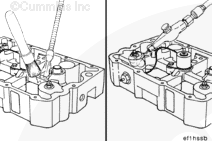
The dial indicator method is the only approved procedure for brake lash adjustment. Studies have determined that adjustments made with a feeler gauge are significantly less accurate than those made with an indicator. Excessive lash can overload the engine's injection train and can result in engine damage.

To maintain a very high level of brake performance on the N14 Plus engine while operating within the valve and injection train capabilities, it is recommended to adjust brake lash with a dial indicator.

NOTE: The dial indicator method can not be used if the adjusting screw has a screwdriver slot. If a screwdriver slot is present, the feeler gauge method will have to be used.

 
SMALL | MEDIUM | LARGE
   

Slave piston adjustments must be made with the engine stopped and cold (stabilized water temperature at 60°C [140°F] or below).

The exhaust valves on the cylinder to be adjusted must be in the closed position.

 
SMALL | MEDIUM | LARGE
   

Rotate the crankshaft in the direction of engine rotation.

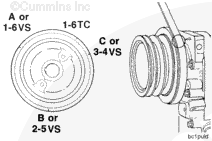
Align the "A" or "1-6VS" mark on the accessory drive pulley with the pointer on the gear cover.

 
SMALL | MEDIUM | LARGE
   

When the "A" or "1-6VS" mark is aligned, the intake and exhaust valve rocker levers must be loose for cylinder 5.

Both the intake and exhaust valves are closed when both rocker levers are loose and can be moved from side to side. If both valves are not closed, rotate the accessory drive one complete revolution; and align the "A" mark with the pointer again.

If the valve rocker lever adjusting screws have been loosened and not yet adjusted, watch the valve push tubes as the engine rolls upon the "A" mark. Both valve push tubes will have moved to the downward (valve closed) position if the engine is on the correct stroke.

 
SMALL | MEDIUM | LARGE
   

The instructions using the "A" or "1-6VS" mark to begin the adjustments are for illustration purposes. Adjustments can start at any of the cylinders as illustrated.

 
SMALL | MEDIUM | LARGE
   

 CAUTION 

Use of the wrong adjusting screw can result in severe engine damage.
 
SMALL | MEDIUM | LARGE
   

Loosen the locknut for the number 5 slave piston adjusting screw.

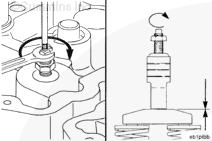
Install a dial indicator, Part Number 3375006, over the number 5 slave piston adjusting screw. Use the adapter, Part Number 3823826, to mount the dial indicator fixture to the engine brake.

Engine brake slave piston lash can not be set within the +/- .051 mm [.002 in] tolerance with a feeler gauge.

Exceeding the tolerance limits will result in low brake power, or possible exhaust valve/piston interference when set on the low side, or excessive component loading which could lead to damage, when set on the high side.

Engine brake slave piston lash must be set using the dial indicator method.


SMALL | MEDIUM | LARGE
   

Tighten the adjusting screw until the slave piston contacts the crosshead.


SMALL | MEDIUM | LARGE
   

Zero the gauge with the dial indicator stem resting on the adjusting screw.


SMALL | MEDIUM | LARGE
   

NOTE: Engine brake adjustment specifications are found on the engine brake dataplate (1) located on the exhaust side of the engine brake housing.

Loosen the adjusting screw until the indicator needle shows 0.58 mm [0.023 in].


SMALL | MEDIUM | LARGE
   

Hold the adjusting screw and tighten the locknut.

Torque Value:  24  n.m  [212 in-lb]


SMALL | MEDIUM | LARGE
   

Repeat this procedure to adjust the remaining slave pistons.

 
SMALL | MEDIUM | LARGE


Finishing Steps

TOC
 WARNING 

Batteries can emit explosive gases. To reduce the possibility of personal injury, always ventilate the compartment before servicing the batteries. To reduce the possibility of arcing, remove the negative (-) battery cable first and attach the negative (-) battery cable last.


SMALL | MEDIUM | LARGE


Last Modified:  30-Nov-2011
Feedback / Help